Showing posts with label Archaeology. Show all posts

Saturday, April 18, 2015

150th Anniversary of the Sinking of Steamboat Bertrand

Canadian geese at DeSoto National Wildlife Refuge
Near Missouri Valley, Iowa on the boarder of Nebraska and Iowa is a Fish and Wildlife Service site called the DeSoto National Wildlife Refuge. The refuge's main purpose is to serve as a stopover for migrating ducks and geese during fall and spring migrations between the Arctic nesting grounds and Gulf Coast wintering areas. Typically 500,000 snow geese and 75,000 ducks migrate through each year.
  
You wouldn't think that a wildlife refuge had anything to do with archaeology and in most cases you would be right, but not this time. DeSoto National Wildlife Refuge is located along an oxbow of the Missouri River. The Missouri River has over 200 known steamboat wrecks and one happens to be on the refuge.
Bertrand excavation in progress

This steamboat named the Bertrand was heading toward a mining town in Montana, but on April 1, 1865 it hit a snag. The boat was brought toward shore and the passengers were evacuated before it sank. For the 150th commemoration of this event, one of the conservators of the artifacts found on board the Bertrand, Ronald Switzer, gave a talk about his research on the artifacts, the history of the boat and passengers on board.

For many years, treasure hunters looked for this shipwreck thinking that there would be gold, mercury (used in the mining process), and whiskey casks. After many attempts to locate the ship it was finally found in 1968, over one hundred years after it first sank. Since it was located on government property these salvagers had to comply with the Antiquities Act of 1906. So they wrote up a contract where they would be allowed to keep the mercury, gold and whiskey casks found on the wreck and all artifacts would belong to the Fish and Wildlife Service for permanent protection.

Unfortunately, in the late 1960's very little had been done in the field of freshwater artifact conservation. The practices used for saltwater conservation are not effective for items submerged in freshwater, therefore many experimental techniques were used on objects to preserve the various materials found on the Bertrand. Luckily the majority of the items were preserved in near pristine condition due to innovative conservation techniques and the anaerobic conditions of the river mud.
Location of excavation site

After two summer of excavating over 250,000 artifacts were discovered. This makes it the largest intact collection of Civil War era artifacts. These artifacts included clothing, household items, tools, canned food, and ammunition. The textile artifacts are of special interest since the techniques used to preserve them left them in near pristine contention. Costume designers, quilters and other people interested in Civil War period fabrics and stitching techniques examine these artifacts for authenticity. While these items are priceless, the salvagers did not find their treasure. They left with only 9 containers worth of mercury since no whiskey casks and only ornamental gold was found in the wreck.

Bertrand exhibit at DeSoto National Wildlife Refuge
The current visitor center was built in 1981 and these wonderful objects were put on public display. The items are located in a glass storage room which allows visitors to see not only the items on display, but also how the rest of the collection is stored.

If you are ever in the area, I recommend visiting the refuge to see this mixture of history and nature.

Wednesday, February 25, 2015

X-Rays Reveal Writing on Ancient Scrolls from Mt. Vesuvius Eruption

Photo courtesy University of Kentucky

Mount Vesuvius erupted in 79 AD destroying the wealthy Roman resort town of Herculaneum along with the better known Pompeii. Beginning in 1738 Charles of Bourbon (Charles III of Spain) sent archaeological teams to Pompeii and Herculaneum to dig up artifacts after Roman items were discovered by well diggers and treasure hunters. In 1752, the team discovered their first scroll and in 1754 they had discovered an entire library of scrolls inside the ancient villa. They uncovered roughly 800 charred scrolls from the library now called "Villa de Papyri" under more than 50 feet (15 meters) of ash. 

As soon as the scrolls were discovered people wanted to know what was written on them. Over the centuries, various techniques were devised to unroll the scrolls, but they usually ended up destroying the brittle papyrus. Historians have tried many methods for reading the damaged scrolls. "They poured mercury on them, they soaked them in rosewater — all kinds of crazy stuff," said Jennifer Sheridan Moss, a papyrologist at Wayne State University in Detroit. Even the most careful unrolling can lead to their destruction. A clever unrolling machine designed by a monk in the 1700s, was fairly successful, but most wound up damaging the fragile documents.

Of the 1,814 scrolls unearthed, around 300 have been deciphered. From those scrolls historians determined that the library was filled mainly with writings on Epicurean philosophy with a large collection of works from a prolific writer named Philodemus.

Photo courtesy Salvatore Laporta/AP


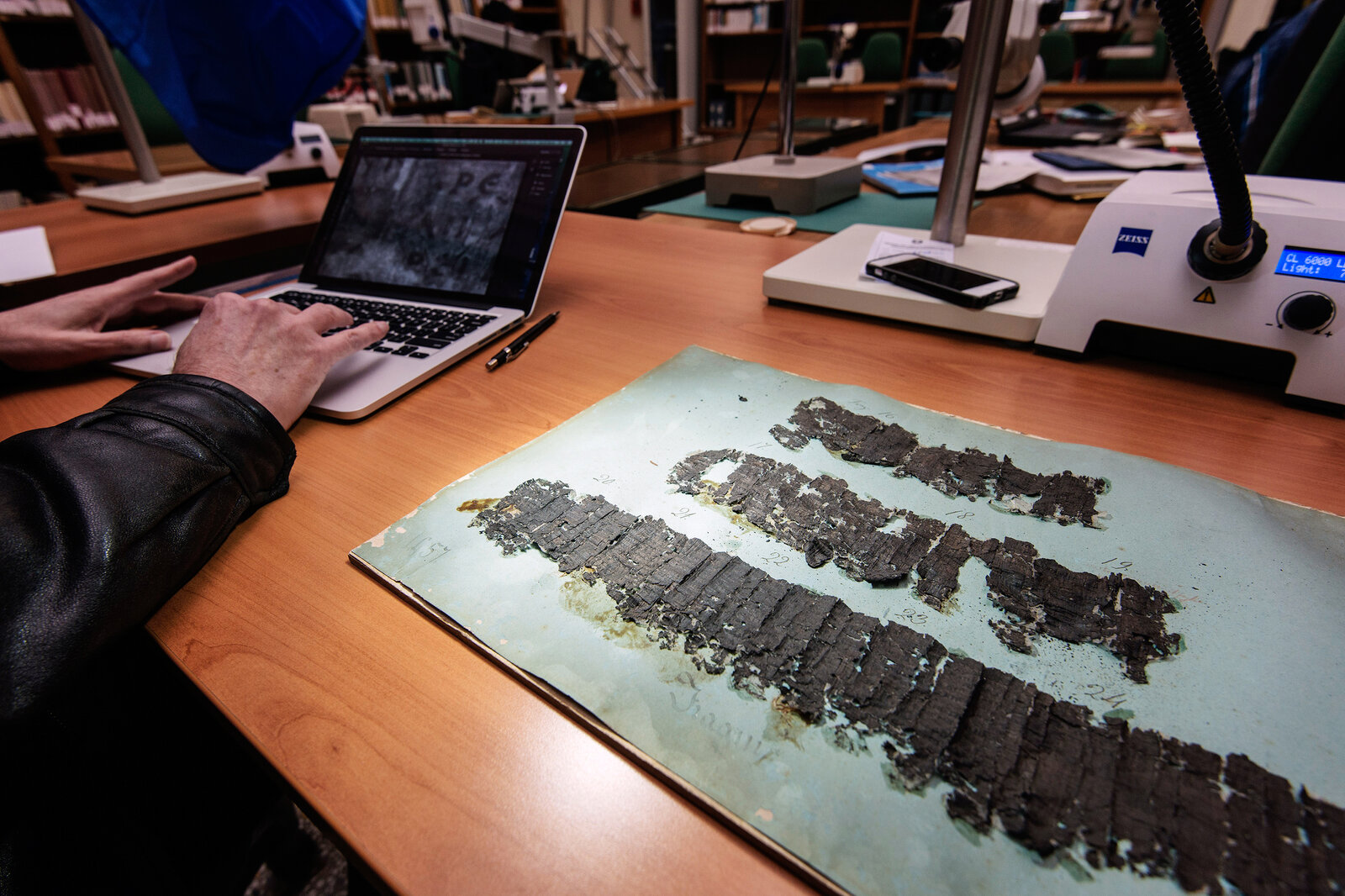
Conventional x-rays of the rolled-up Herculaneum scrolls don't reveal anything because the Herculaneum scrolls presented a unique challenge: papyrus was burnt and the text was written with black, carbon-based ink. Common X-ray techniques could not detect the pattern variations between the ink and the papyrus, so researchers tried an x-ray technique which reads the text through the rolled-up papyrus by discerning charcoal ink from charred papyrus. 

 This new approach, called X-ray phase-contrast tomography (XPCT), builds a higher-definition image by detecting the slight relief between the letters and the papyrus. The letters rise just one hundred microns above the papyrus, but that’s enough to build a clearer picture than any other technique. Similar to a medical CT scan, the new process produced a three-dimensional view of the folded, compressed interior of the charred scroll. Unlike regular x-rays, the method can distinguish the charcoal ink from the surface of the charred papyrus.

The scrolls’ small sizes and numerous folds make it difficult to focus on every letter or gauge the letter’s orientation. But what’s important is that researchers proved that you could peek inside these ancient scrolls without destroying them.


Image by Vito Mocella/ Nature Communications


Studying the interior surface of the scroll, the researchers demonstrated they were able to read letters, a few microns thick, written on the papyrus long ago. A first effort deciphered 24 letters used in ancient Greek, the language of philosophy in the Roman world.
 
It is going to be a while before the scrolls are completely interpreted. However, researchers’ new technique is an encouraging start. Using XPCT, researchers examined two scrolls and could clearly see letters that formed short phrases such as “would fall” or “to deny,” but not much more. Daniel Delattre of the Institute for the Research and History of Texts in Paris examined the handwriting of the few letters and words that the team was able to recover. He compared the handwriting to that in other Herculaneum scrolls, and found a match with a scribe writing in the first century bc. Given that scribe’s activity in other scrolls, the new text is likely to be a copy of writing by the philosopher and poet Philodemus.
 
Villa de Papyri
Long ago archaeologists gave up on opening the texts to spare the culturally important artifacts, but this imaging technique allows researchers to see what’s written inside, without ever opening the delicate artifacts. The researchers hope that the method leads to a non-destructive way to investigate more of Herculaneum's charred papyri, which in turn will reopen consideration of more excavations at the Villa de Papyri. 

Scholars have long pondered the possibility of another library buried deeper beneath its ruins because most Roman libraries held the Greek treatises in one section and Latin books in another. If they do find the hidden library, this new technique could become very useful.

Saturday, February 7, 2015

What is Archaeology?

Archaeology is the study of human cultures through material remains. Archeologists have different interests and focus on studying different locations and times, ranging from earliest human ancestors in Africa to present-day. Listed below are the main categories of archaeological study
  • Prehistoric archaeology focuses on past cultures that did not have written language. Therefore, most prehistoric archeology relies primarily on survey and excavation, or data recovery, to explore the past.
  • Historical archaeology studies cultures that existed during the period of recorded history--several thousands of years in parts of the world, but only several hundred years in others. Within historical archaeology there are many geographically specific fields of study that include classical archaeology, Egyptology, and biblical archaeology.
  • Underwater archaeology studies physical remains of human activity that lie beneath the surface of oceans, lakes, rivers, and wetlands. It includes the study of shipwrecks, cities and harbors that are now submerged.
  • Ethnoarchaeology is the study of living cultures resembling extinct ones for archaeological purposes. It usually involves the study of surviving hunter-gatherers, pastoralists and nomads to attempt to  explain objects and findings from archaeological sites.
Some of the other specialties within archaeology include , urban archaeology, experimental archaeology, cultural resource management (CRM), and bioarchaeology.

What is Anthropology?

Anthropology comes from the Greek words anthropos meaning human and logia meaning study. Therefore, anthropology literally means the study of humans. Anthropologists seek to understand humans from the earliest hominids millions of years ago to people living today using many different methods. Anthropology draws on knowledge from many areas including social science, biological science, humanities and physical science. There are many areas anthropologist study including...
  • Cultural Anthropology - Seeks to understand the internal logic of societies through ethnography
  • Linguistic Anthropology - Seeks to explain the very nature of language and its use by humans
  • Archaeology - Retrieves artifacts from the past and places them in context to understand our history and its relevance for today
  • Physical Anthropology - Traces our biological origins, evolutionary development, and genetic diversity
  • Forensic Anthropology - Seeks to identify skeletal, or otherwise decomposed, human remains
  • Medical Anthropology - Seeks to better understand factors that influence peoples' health and well being
  • Environmental Anthropology - examines the relationships between humans and their environment across space and time